Sports therapy clinic
Sixteen condition guides and one booking link, for a clinic of one
A single-therapist clinic in central London, listed next to practices with six practitioners and a receptionist. The site explains what each treatment is for, answers sixteen common problems in depth, and points every visitor at one booking page.
 Open rehabjoy.com ↗
What they came to us with
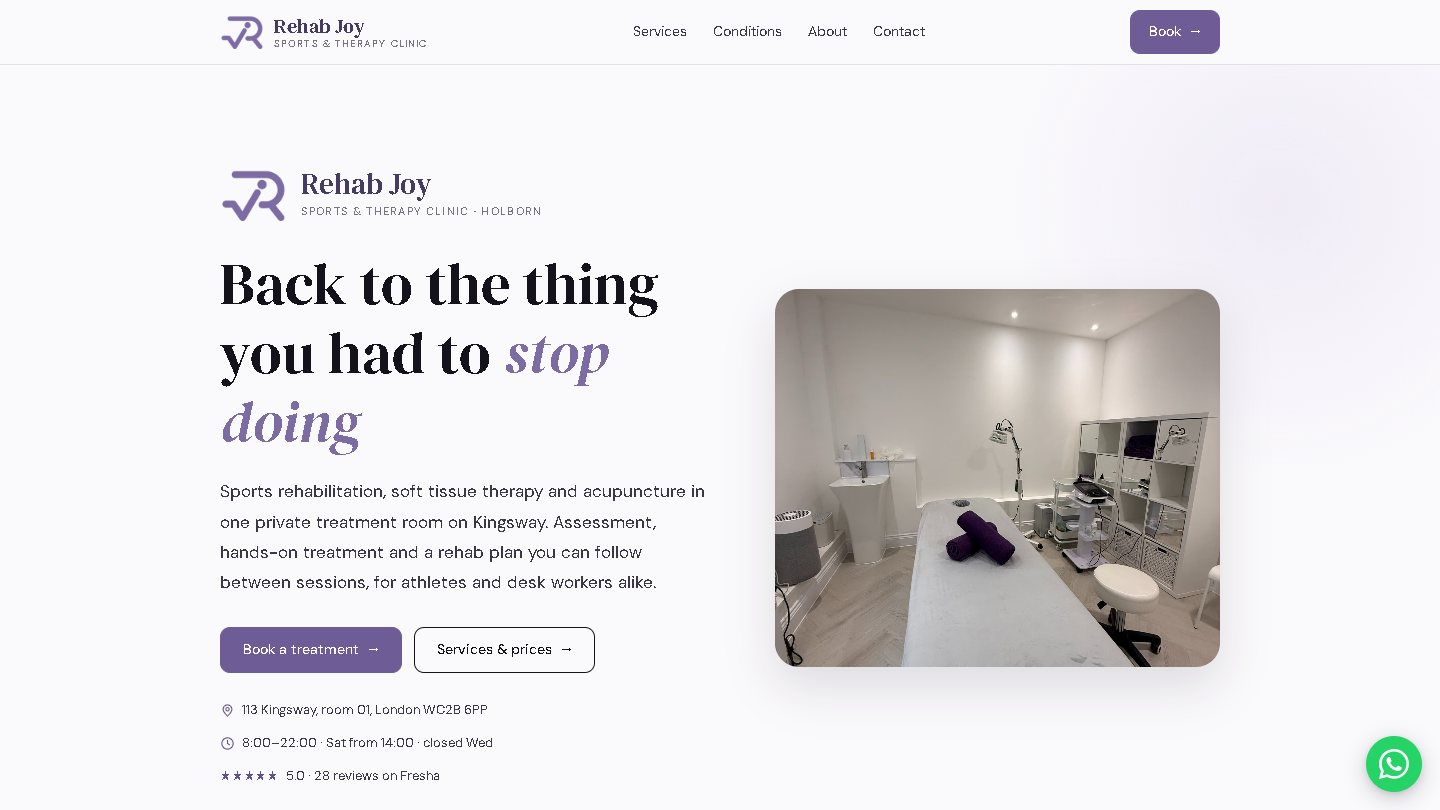
A sports therapy clinic in a treatment room inside a shared wellness suite in Holborn, run by the one therapist who treats in it. In central London it appears alongside multi-practitioner practices, and somebody choosing between them has about twenty seconds to work out what this clinic actually does.
The treatments are also easy to confuse. Sports rehabilitation, deep tissue work, shockwave, instrument therapy, acupuncture and cupping all sit close together in a patient's mind, and a visitor who cannot tell them apart either books the wrong one or books nothing.
What they got
Explaining what each treatment is for
- Six treatments set out plainly: sports rehabilitation, deep tissue and soft tissue therapy, shockwave and ultrasound, instrument therapy and taping, acupuncture and cupping, and home visits.
- A short “book this one if…” comparison for the two treatments people mix up most, so a visitor picks correctly instead of arriving for the wrong appointment.
- Every price on the page, in a table that matches the printed list in the treatment room, each line labelled in English and Chinese for the clinic's Mandarin-speaking patients.
- The assessment that comes first is stated up front, so nobody books expecting an hour of massage.
A guide for each problem people search for
- Sixteen in-depth guides covering what the clinic treats most: low back pain, sciatica, neck pain, frozen shoulder, rotator cuff, tennis elbow, hamstring strain, shin splints, Achilles, patellar and gluteal tendinopathy, patellofemoral pain, heel pain, ankle sprain, and recovery after hip and knee replacement.
- Grouped by part of the body rather than by clinical name, so somebody who does not know what their problem is called can still find the right page.
- All sixteen share one layout and one set of writing rules, so adding the seventeenth is a matter of writing it rather than building a page.
- Each guide carries the same booking button at the end, so somebody who reads the whole thing never has to navigate back to act on it.
Making it easy to book, or just to ask
- One booking route only, straight into the clinic's real diary, reachable from every page on the site.
- A WhatsApp button that follows the page down, for the patients who will send a message and never fill in a form.
- An enquiry form for the questions that come before a booking, landing in the clinic inbox with no charge per enquiry.
- The building, the room number and the nearest stations are all given, because a room inside a shared suite is exactly where a first-time patient gets lost.
- Opening hours as they really are, including the day the clinic is closed and the evenings it is open until ten.
A site the clinic owns outright
- Colours and type drawn from the clinic's own logo, so the site, the price poster and the booking page look like one business.
- No monthly platform fee and no subscription for the site itself, and no plugins that break at 2am.
- Training and certificates published where a patient can see them, which is what a single-practitioner clinic has instead of a brand.
- Search engines are given a fresh map of the site whenever a page is added, so new guides get found rather than waiting to be stumbled on.
- Photographs of the actual room, since a patient booking a treatment inside a shared building wants to see where they are going.
How we went about it
A solo clinic cannot pretend to be a group, and the visitors it wins are the ones who wanted the same person every session. The site says so on the first screen.
Each one covers a condition the clinic actually treats, at enough depth to be worth reading. Sixteen thin pages would have ranked for nothing and helped nobody.
Every button on the site goes to the same place. A clinic of one cannot manage three inboxes and a phone line during a treatment.
The prices online are the prices on the wall, in both languages. A patient finding a difference between them stops trusting either.
What we would tell you before you start
A single-practitioner clinic competes on being specific. Sixteen guides written about the conditions it genuinely treats do more than a longer list of services, because they answer the thing the patient typed.
The guides are the slow part and the durable part. They were built from one shared layout so the clinic can keep adding to them for years without the site drifting into sixteen slightly different designs.
Find out what your clinic is missing
A free 20-minute review of your website, Google Business Profile, reviews and booking flow. You get a written summary of what to fix first, whether or not you work with us.